
Start Your Navodaya Preparation Today
Every year, many students dream of studying at a Jawahar Navodaya Vidyalaya (JNV). These schools offer quality education, residential facilities and opportunities for students from different backgrounds. For many families, getting admission to a Navodaya Vidyalaya is an important educational goal.
However, success in the Jawahar Navodaya Vidyalaya Selection Test (JNVST) requires more than hard work. Students need to understand the syllabus, practise the right questions, improve their speed and revise regularly.
If you’re wondering how to prepare for JNVST 2027 in 90 days, this guide will help you create a clear study plan. You’ll learn how to divide your time, prepare each subject, use mock tests and avoid common mistakes.
A quick date reminder: The JNVST 2027 Class VI entrance examination is scheduled for 28 November 2026. If you’re beginning on 12 October 2026, you have around 47 days, not 90. Don’t worry. You can still use the strategies in this article by focusing on the most important topics, regular practice and revision.
1. Understand the JNVST 2027 Exam Pattern
Before you start studying, understand the examination structure. This helps you decide how much time to give each subject.
According to the JNVST 2027 Class VI examination information, the paper has 80 objective-type questions carrying 100 marks. The examination lasts two hours.
| Section | Questions | Marks |
|---|---|---|
| Mental Ability Test | 20 | 25 |
| Environmental Studies (EVS) | 20 | 25 |
| Arithmetic Test | 20 | 25 |
| Language Test | 20 | 25 |
| Total | 80 | 100 |
Each correct answer carries 1.25 marks, and there is no negative marking according to the published examination information. Always verify the final rules against the official prospectus before the test.
The current pattern includes Environmental Studies (EVS), so students shouldn’t rely only on older preparation books that may follow a different syllabus.
Why should you understand the exam pattern?
- You can divide your study time more effectively.
- You know which sections require extra practice.
- You can plan your mock tests around the real examination.
- You can avoid spending too much time on one subject.
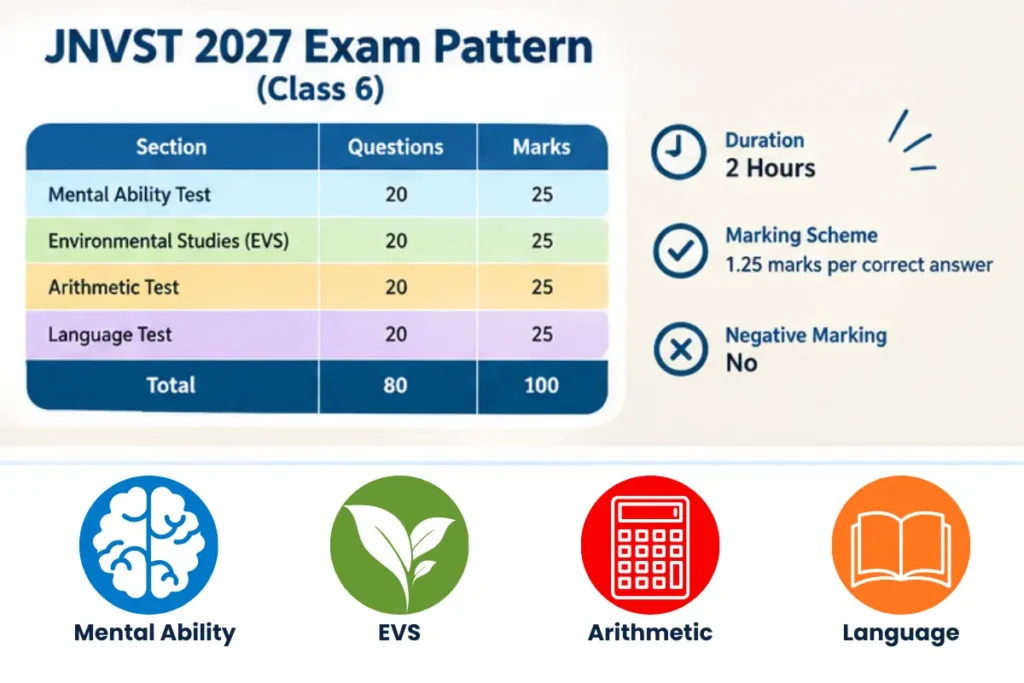
Start by writing the four sections in a notebook. Under each heading, list the topics you know well and the ones you find difficult. This simple exercise will give you a starting point.
2. Know the Latest JNVST 2027 Syllabus
The syllabus is your preparation roadmap. Studying without it is like travelling without knowing your destination.
For JNVST 2027, focus on the topics listed in the applicable official prospectus. The main areas are Mental Ability, Environmental Studies, Arithmetic and Language.
| Subject | What to practise |
|---|---|
| Mental Ability | Figure patterns, figure series, geometrical figure completion, mirror and water images, embedded figures |
| Environmental Studies | The natural world, human body, science in daily life and social surroundings |
| Arithmetic | Number operations, fractions, decimals, measurement, simplification, perimeter, area, angles, directions and data interpretation |
| Language | Reading comprehension, understanding passages, finding answers and improving reading accuracy |
This is a preparation overview, not a replacement for the complete official syllabus. Read the prospectus carefully because topic lists and examination formats can change between sessions.
How to make a useful syllabus checklist
- Write down every topic from the official syllabus.
- Mark topics you can answer confidently.
- Circle topics that need more practice.
- Assign a target date to each topic.
- Revisit difficult topics after a few days.
Don’t try to memorise the entire syllabus in one sitting. Study a small topic, solve questions on it and review your mistakes. Gradual improvement is more useful than rushing through chapters without understanding them.
3. Follow a 90-Day JNVST Preparation Plan
A good study plan divides preparation into three stages: learning, practice and revision. This gives students a clear direction and makes progress easier to track.
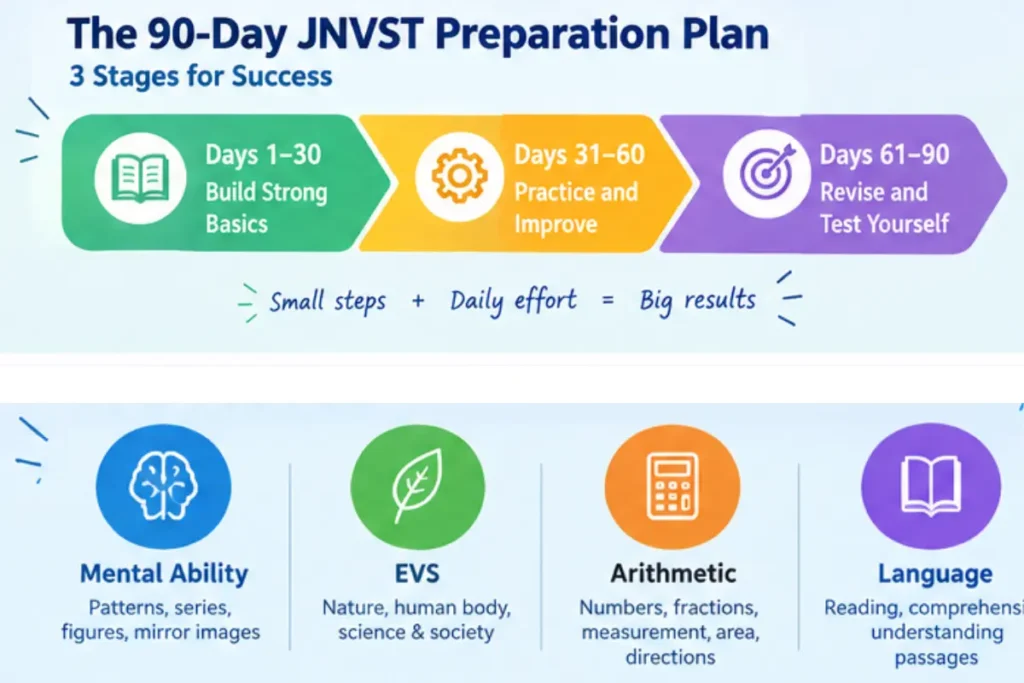
Days 1–30: Build Strong Basics
The first month should focus on understanding the syllabus and learning the fundamentals.
Your goals:
- Complete an initial assessment using sample questions.
- Learn basic Arithmetic concepts.
- Practise different Mental Ability question types.
- Read short passages every day.
- Study EVS topics from the prescribed syllabus.
- Maintain a notebook of mistakes and important concepts.
Days 31–60: Practise and Improve
The second month should focus on solving more questions and improving accuracy.
Your goals:
- Practise topic-wise question sets.
- Solve questions within time limits.
- Review mistakes from the first month.
- Take regular mock tests.
- Improve reading speed and comprehension.
- Strengthen weak topics without neglecting strong ones.
Days 61–90: Revise and Test Yourself
The final month is for revision, practice papers and exam readiness.
Your goals:
- Revise all important topics.
- Solve full-length mock tests under timed conditions.
- Practise marking answers carefully.
- Review frequently repeated mistakes.
- Avoid starting too many unfamiliar resources.
- Maintain a regular sleep and study schedule.
4. Prepare for the Mental Ability Test
Mental Ability requires students to observe patterns and understand relationships between figures. Regular practice can improve both speed and accuracy.
Begin with simple questions and gradually move to more challenging ones.
Important preparation tips
Observe every detail. Check the direction, position, size and number of shapes.
Learn one pattern at a time. Practise figure series, mirror images and embedded figures separately before mixing them.
Use elimination carefully. If an option clearly breaks the pattern, remove it and compare the remaining choices.
Practise under a time limit. First learn to solve a question correctly. Then work on solving it faster.
Review every mistake. If you choose the wrong figure, identify the pattern you missed.
For example, a series might show a triangle rotating by the same angle in each step. Instead of guessing the next figure, observe the rotation and apply the same rule.
Create a daily Mental Ability practice target. A small set of carefully reviewed questions is often more helpful than a large set completed in a hurry.
5. Prepare for Environmental Studies
Environmental Studies is an important part of the JNVST 2027 pattern. Students should not ignore it while preparing for Mathematics and Mental Ability.
Study the topics specified in the official syllabus, including the natural world, the human body, science in daily life and social surroundings.
How to study EVS effectively
- Read short sections and explain them in your own words.
- Connect concepts to things you see at home, school and in your community.
- Make brief notes about important facts.
- Practise multiple-choice questions after each topic.
- Revise incorrect answers regularly.
A simple method for solving Maths questions
- Read the question carefully.
- Identify the information provided.
- Decide which operation or formula is needed.
- Solve the problem step by step.
- Check whether the answer makes sense.
Suppose a question asks you to calculate the perimeter of a rectangle. First identify its length and breadth. Then use the correct formula:
Perimeter = 2 × (Length + Breadth)
7. Strengthen Your Language Test Preparation
The Language section tests how well you understand written passages. Students should practise reading carefully and finding answers from the given text.
Daily reading routine
- Read one or two short passages.
- Identify the main idea of each passage.
- Find the meaning of unfamiliar words from context.
- Answer questions using information in the passage.
- Check whether your answers are supported by the text.
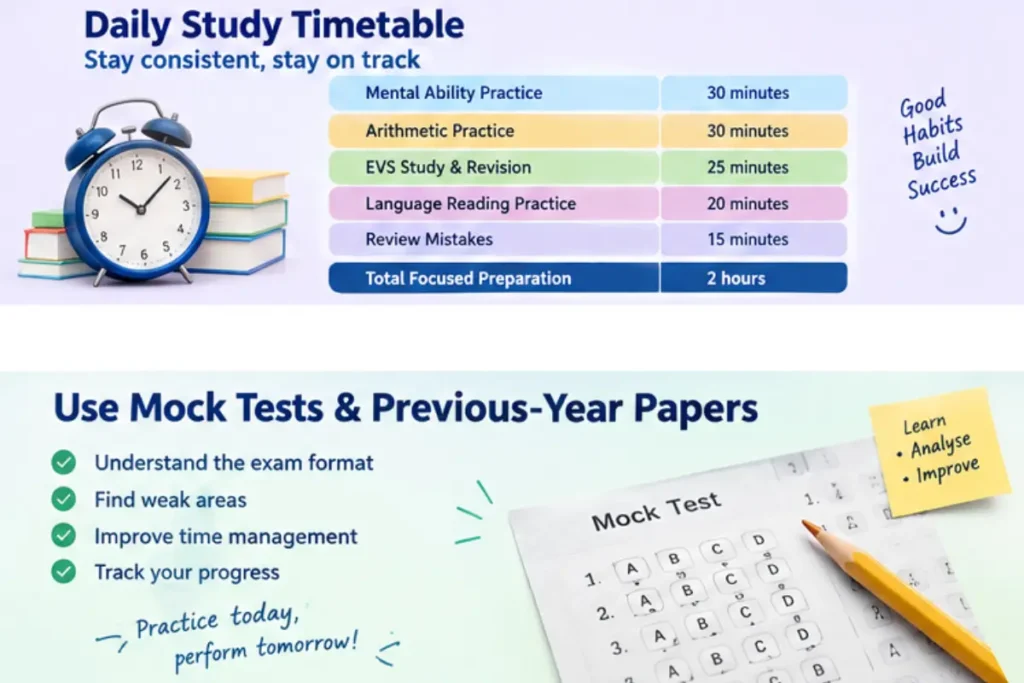
8. Create a Daily JNVST Study Timetable
A timetable helps students balance all four sections. It should be realistic enough to follow every day.
Here is an example for a student who has school and other daily responsibilities.
| Study activity | Suggested time |
|---|---|
| Mental Ability practice | 30 minutes |
| Arithmetic practice | 30 minutes |
| EVS study and revision | 25 minutes |
| Language reading practice | 20 minutes |
| Review mistakes | 15 minutes |
| Total focused preparation | 2 hours |
These times are flexible. Students who have more time can add a practice test or a revision session. Those with schoolwork should adjust the timetable to protect adequate sleep and rest.
Follow these timetable rules
- Study at a regular time whenever possible.
- Keep books and practice materials ready.
- Take short breaks between focused sessions.
- Review the day’s mistakes before finishing.
- Track completed topics rather than merely counting study hours.
9. Use Mock Tests and Previous-Year Papers Wisely
Mock tests help you understand the examination format and identify areas that need improvement. Previous-year papers can also provide useful practice, but students should check whether the questions match the current syllabus.
Try to practise under conditions similar to the actual examination. Sit in a quiet place, use a timer and avoid interruptions.
After completing a test, record:
- Your score.
- The number of correct and incorrect answers.
- Questions left unanswered.
- Topics that caused difficulty.
- Mistakes caused by rushing or misunderstanding.
Review your results before attempting another paper.
10. Avoid Common JNVST Preparation Mistakes
Even hardworking students can lose progress through poor study habits. Watch out for these common mistakes.
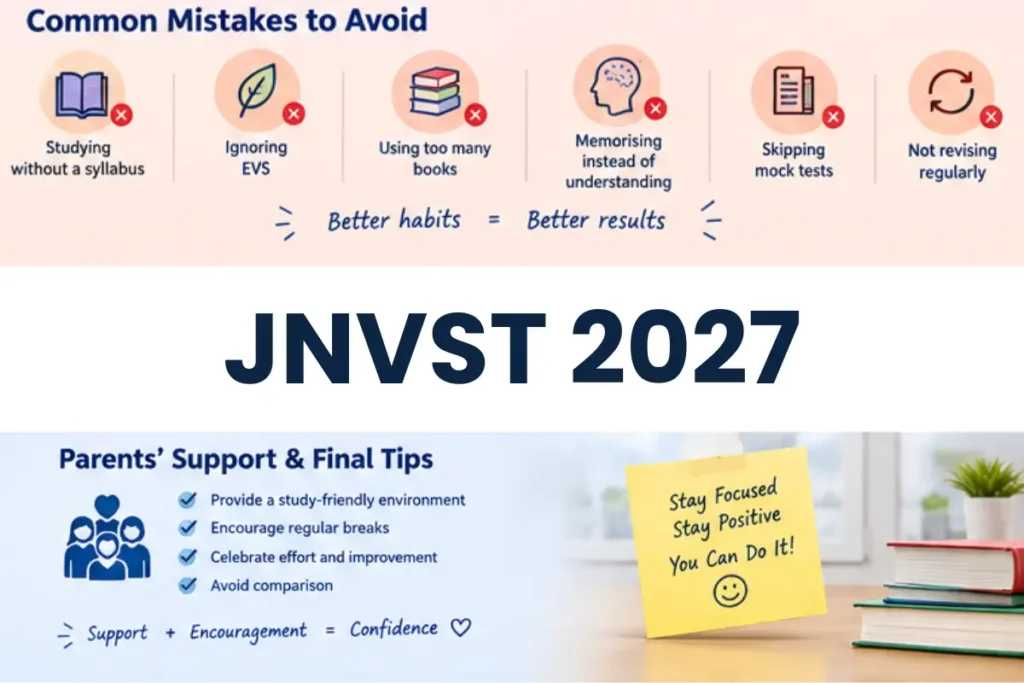
Studying without a syllabus: You may spend time on topics that aren’t part of the current examination. Use the official prospectus as your guide.
Ignoring EVS: The current pattern includes EVS, so give it regular study time.
Using too many books: Constantly switching resources can create confusion. Choose suitable materials and complete them systematically.
Memorising without understanding: Memorisation alone may not help when questions are presented in a new way. Learn the concept and practise applying it.
Avoiding mock tests: Practice papers help develop time management and reveal weak areas.
Skipping revision: Topics that aren’t reviewed can become difficult to recall. Revisit earlier lessons regularly.
Comparing yourself with others: Every student starts at a different level. Track your own improvement instead.
Studying late into the night: Lack of sleep can affect concentration and memory. Maintain a healthy routine, especially during the final week.
11. How Parents Can Support JNVST Aspirants
Parents play an important role in a child’s preparation. Their support should build confidence rather than create unnecessary pressure.
Start by helping your child establish a regular study routine. Provide a quiet place to study, keep the necessary books available and encourage regular breaks.
Ask about learning progress instead of checking only marks. Questions such as “Which topic did you understand today?” or “What was difficult in your practice test?” can lead to useful discussions.
Practical ways to help
- Celebrate consistent effort and improvement.
- Help your child follow the study timetable.
- Arrange suitable practice materials.
- Discuss mistakes calmly and constructively.
- Ensure adequate sleep, meals and physical activity.
- Avoid comparing your child with classmates or relatives.
12. How eduNEET Junior Can Support JNVST Preparation
Students sometimes find it difficult to decide what to study, which questions to practise and how to understand the latest examination pattern. A structured preparation programme can help organise these tasks.
eduNEET Junior offers online coaching for JNVST aspirants, with preparation support designed around the needs of students and parents.

Before choosing any coaching programme, parents should check:
- Whether the course follows the current JNVST 2027 syllabus.
- Whether lessons explain concepts clearly.
- Whether students receive enough question practice.
- Whether doubt-clearing support is available.
- Whether progress can be reviewed regularly.
- Whether the teaching language suits the student.
No coaching programme can guarantee admission. The student’s effort, regular practice and understanding remain essential.
Parents looking for guidance can explore the eduNEET Junior JNVST preparation page for available course information.
Frequently Asked Questions About JNVST 2027 Preparation
1. Can I prepare for JNVST 2027 in 90 days?
Yes, 90 days can provide a useful preparation period if you follow a structured timetable, cover the prescribed syllabus and practise regularly. However, the scheduled JNVST 2027 Class VI exam is on 28 November 2026. Students starting on 12 October have around 47 days, so they should use an accelerated plan.
2. How many hours should I study daily for JNVST?
There is no single study-hour requirement that works for every child. Around two focused hours outside school can be a reasonable starting point for some students. Adjust the schedule to your child’s current preparation level, schoolwork and need for rest.
3. Which subjects are included in JNVST 2027?
The current Class VI pattern includes Mental Ability, Environmental Studies (EVS), Arithmetic and Language. Check the official prospectus for the complete topic list and examination instructions.
4. Is Mental Ability important for JNVST preparation?
Yes. Mental Ability carries 25 marks in the published 2027 pattern. Practise figure patterns, figure series, mirror images, water images and other prescribed question types regularly.
5. Are previous-year question papers enough to prepare for JNVST?
Previous-year papers are useful, but they shouldn’t be your only resource. Since the 2027 pattern includes changes, combine suitable past questions with the current syllabus, topic-wise practice and mock tests aligned with the latest format.
6. Is there negative marking in JNVST 2027?
The published examination information states that there is no negative marking. Confirm the instructions in the official prospectus and follow the directions given on examination day.
7. What should I do during the last week before JNVST?
Revise important concepts, review mistakes, practise selected questions and maintain a normal sleep schedule. Avoid starting several new books or attempting to learn the entire syllabus at the last moment.
8. Can online coaching help with Navodaya entrance exam preparation?
Online coaching can offer structured lessons, practice questions and guidance. Its usefulness depends on the quality of teaching, syllabus alignment and the student’s regular participation. Parents should check course details before enrolling.
Conclusion: Prepare Smartly and Stay Confident
Preparing for JNVST 2027 becomes easier when students follow a clear plan. Understand the current syllabus, practise all four sections, review mistakes and use mock tests to improve time management.
If you have 90 days, divide them into learning, practice and revision stages. If you’re starting closer to the scheduled examination, focus on the most important topics, regular timed practice and careful revision.
Parents should provide encouragement, a supportive study environment and realistic expectations. Students should remember that progress comes from consistent effort, not from studying under constant pressure.
Start today, practise with purpose and keep improving one question at a time.